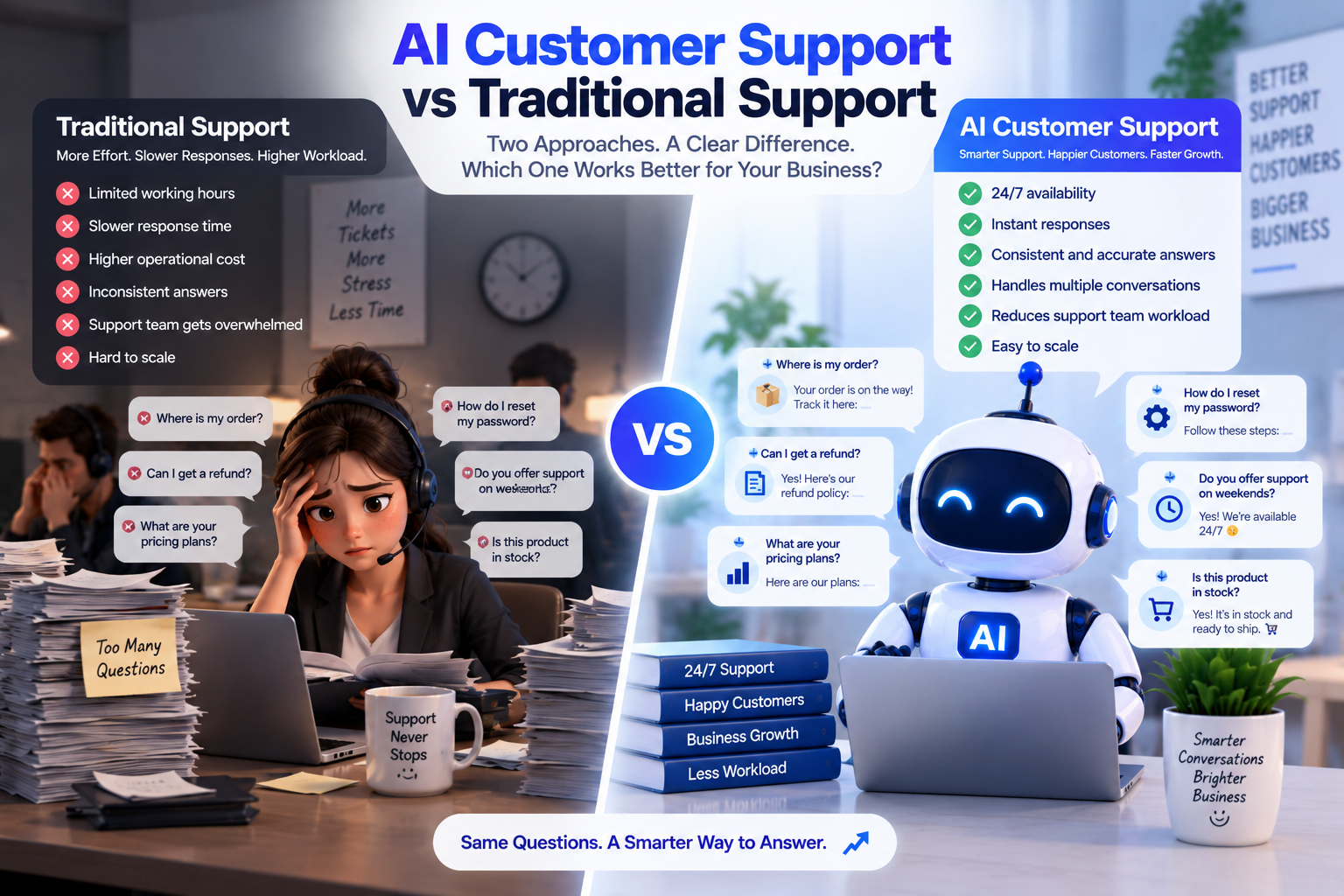
Customer support is one of the most important parts of any business.
Customers want quick answers, helpful information, and an easy way to get assistance when they have a problem. Traditionally, businesses have relied on human support teams to handle customer questions through phone calls, emails, live chat, and support tickets.
But as businesses grow and customer expectations increase, managing every conversation manually can become difficult.
This is where AI customer support is changing the way businesses handle customer interactions.
AI support agents can answer common questions, provide information, and assist customers 24/7, while human support teams can focus on more complex situations.
So, how does AI customer support compare with traditional support?
Let's look at the key differences.
What Is Traditional Customer Support?
Traditional customer support relies primarily on human employees to communicate with customers.
Customers may contact a business through:
- Phone calls
- Live chat
- Contact forms
- Support tickets
- Social media
A support representative reads the customer's question, finds the relevant information, and provides a response.
Human support has an important advantage: people can understand emotions, handle complicated situations, and make decisions that may require judgement.
However, traditional support can become difficult to scale when the number of customer enquiries increases.
What Is AI Customer Support?
AI customer support uses artificial intelligence to automate customer conversations and provide assistance.
An AI support agent can understand natural-language questions and use a business's knowledge base to provide relevant answers.
For example, a customer might ask:
"What are your pricing plans?"
Instead of waiting for a support representative, an AI agent can immediately provide the relevant pricing information.
AI can also answer frequently asked questions, explain products and services, guide customers through common problems, and help capture potential leads.
AI Customer Support vs Traditional Support
The biggest difference is how customer conversations are handled.
| Feature | Traditional Support | AI Customer Support |
|---|---|---|
| Availability | Usually business hours | 24/7 |
| Response time | Minutes to hours | Usually instant |
| Repetitive questions | Handled manually | Can be automated |
| Multiple conversations | Limited by team size | Can handle many conversations simultaneously |
| Scalability | Requires additional staff | Easier to scale |
| Complex issues | Excellent | Can transfer to humans |
| Human interaction | High | Available when needed |
| Operating workload | Higher | Lower for routine queries |
AI and traditional support each have their strengths. The most effective approach for many businesses is to combine them.
1. Response Time
Response speed is one of the biggest differences between AI and traditional support.
A human support team may receive multiple requests at the same time. During busy periods, customers may have to wait before receiving an answer.
An AI support agent can respond to routine questions almost instantly.
For example:
Customer: "Do you offer refunds?"
AI Agent: "Yes. Our refund policy allows eligible customers to request a refund within the specified period. Here's how the process works..."
The customer receives information immediately without waiting for a support employee.
Faster responses can create a better customer experience and keep website visitors engaged.
2. 24/7 Availability
Traditional support teams generally operate according to working hours.
AI agents don't need to follow the same schedule.
A website visitor can interact with an AI customer support agent at midnight, on weekends, or during holidays.
This makes 24/7 customer support particularly useful for businesses with customers in different locations and time zones.
Instead of displaying:
"We'll get back to you during business hours."
businesses can provide immediate assistance through an AI agent.
3. Handling Repetitive Questions
Support teams often answer the same questions repeatedly.
Pricing, product features, delivery information, account instructions, return policies, and business hours are common examples.
When humans handle every one of these questions manually, valuable time is consumed.
An AI agent can automate many of these repetitive conversations.
This allows support employees to spend less time answering basic questions and more time solving complex customer issues.
4. Handling Multiple Conversations
A human support representative can only manage a limited number of conversations at the same time.
When support demand increases, customers may experience longer waiting times.
AI agents can handle many routine conversations simultaneously.
This can be especially useful during:
- Product launches
- Sales campaigns
- Seasonal demand
- Promotions
- Traffic spikes
- Business growth
AI therefore provides businesses with a more scalable way to handle increasing customer interactions.
5. Human Support Is Still Important
While AI has significant advantages, traditional human support isn't going away.
Some customer issues require empathy, judgement, creativity, or decision-making.
For example, a customer dealing with a complicated complaint may prefer speaking directly with a human representative.
This is why businesses should not think of AI as simply replacing human employees.
Instead, AI can handle the routine, while humans handle the complex.
AI can handle:
- Frequently asked questions
- Basic product information
- Pricing questions
- General enquiries
- Simple troubleshooting
- Initial customer interactions
Human agents can handle:
- Complex problems
- Sensitive situations
- Escalated complaints
- Special requests
- High-value customer interactions
This creates a hybrid customer support model.
AI + Human Support: The Best of Both Worlds
The strongest customer support strategy may not be choosing between AI and humans.
It may be using both.
Imagine a customer visiting your website.
First, the AI agent answers their question.
If the question is simple, the conversation ends there.
If the customer has a complicated issue, the AI agent can direct the conversation to a human support representative.
This approach allows businesses to automate what can be automated while keeping human support available when it matters.
Which Is More Cost-Effective?
Traditional customer support requires businesses to hire, train, and manage support employees as customer demand increases.
AI customer support can automate a large portion of routine conversations.
This doesn't mean AI eliminates all support costs. Businesses still need people to manage complex cases, maintain business information, monitor AI performance, and improve support processes.
However, automating repetitive conversations can help businesses use their support resources more efficiently.
The goal should be better productivity rather than simply reducing headcount.
Which Is Better for Your Business?
The answer depends on your business and the type of customer support you provide.
If your customers frequently ask simple and repetitive questions, AI customer support can provide significant value.
If your business handles highly complex or sensitive customer issues, human support will remain essential.
For many businesses, the ideal solution is a combination:
AI for speed and scale + Humans for expertise and empathy.
This gives customers immediate assistance while ensuring that complex issues can still receive personal attention.
The Future of Customer Support
Customer support is moving toward a more hybrid model.
AI agents will increasingly handle repetitive and high-volume conversations, while human support teams will focus on complex, important, and relationship-driven interactions.
As AI technology improves, support agents will become better at understanding customer intent, searching business information, personalizing conversations, and guiding customers toward the right solutions.
Businesses that combine these capabilities with strong human support can create a faster and more efficient customer experience.
Final Thoughts
The debate isn't simply about AI customer support vs traditional support.
It's about using the right technology for the right type of conversation.
Traditional support provides the human connection customers need for complex situations, while AI customer support provides speed, availability, automation, and scalability.
For many modern businesses, the best approach is to let AI handle repetitive questions and allow human support teams to focus on conversations that require real human expertise.
AI handles the routine. Humans handle the important. Together, they create better customer support.